
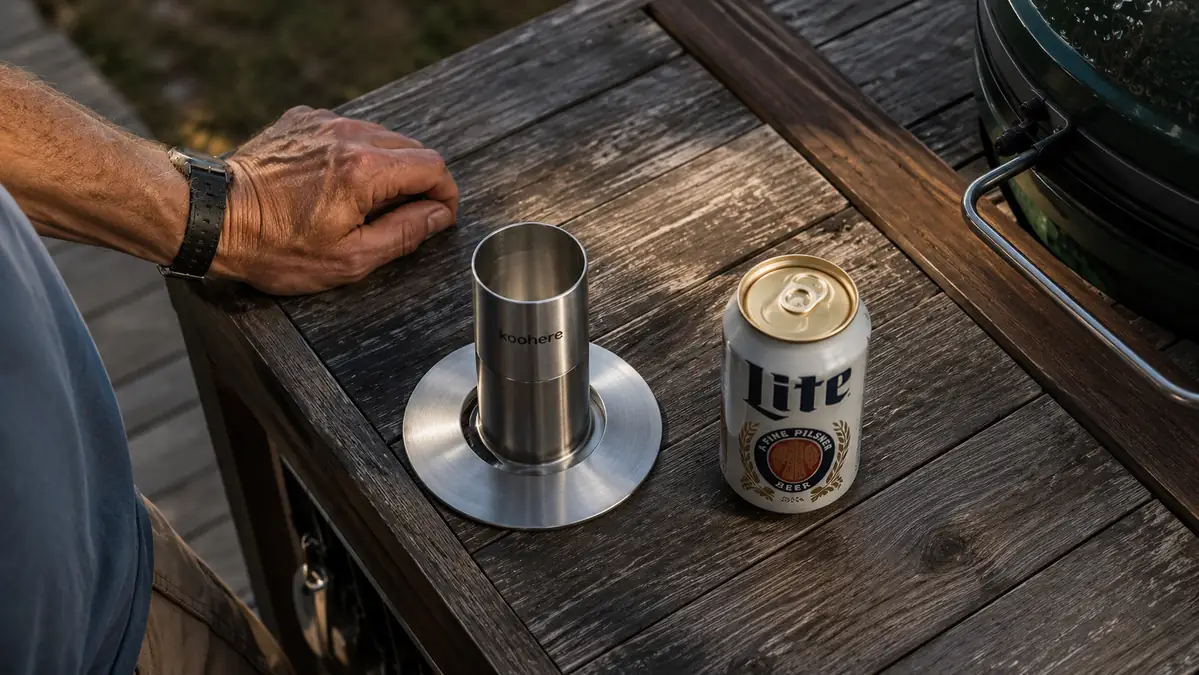
Short answer, if you're standing in your kitchen right now with a whole chicken thawed and no plan yet: I bought a Koohere stainless steel chicken holder about a year ago after years of fishing half-crushed beer cans out of a hot bird with a pair of tongs, and it changed how I roast a whole chicken for good. Not because the beer can method doesn't work, it does, I used it for over a decade before that, but because the Koohere holder solves problems the can was never built to solve, and once you've grilled a chicken both ways back to back, it's hard to go back to balancing dinner on an empty can.
I'm Curtis Boone. Twenty some years on a fire department in coastal North Carolina taught me to respect anything that can tip over near open flame, and a half-full can of beer balanced under eight pounds of raw chicken is exactly that kind of anything. I ran the beer can trick for years at station cookouts and backyard parties, and I've had a can shift sideways on the grate more than once, dumping warm beer and chicken drippings straight onto hot coals in a cloud of steam that sent everybody standing nearby a step back. The Koohere holder is a purpose-built stainless steel stand with a wide base and a carrying handle, made to do the one job a beer can was never actually designed for. Let's break down where each one earns its spot on your grill, because I don't think the can is worthless, it's just outclassed in most of the ways that matter for a normal Sunday cookout.
| Koohere Chicken Holder | Beer Can Method | |
|---|---|---|
| Material | Premium grade stainless steel, wide flat base | Thin aluminum can, curved unstable base |
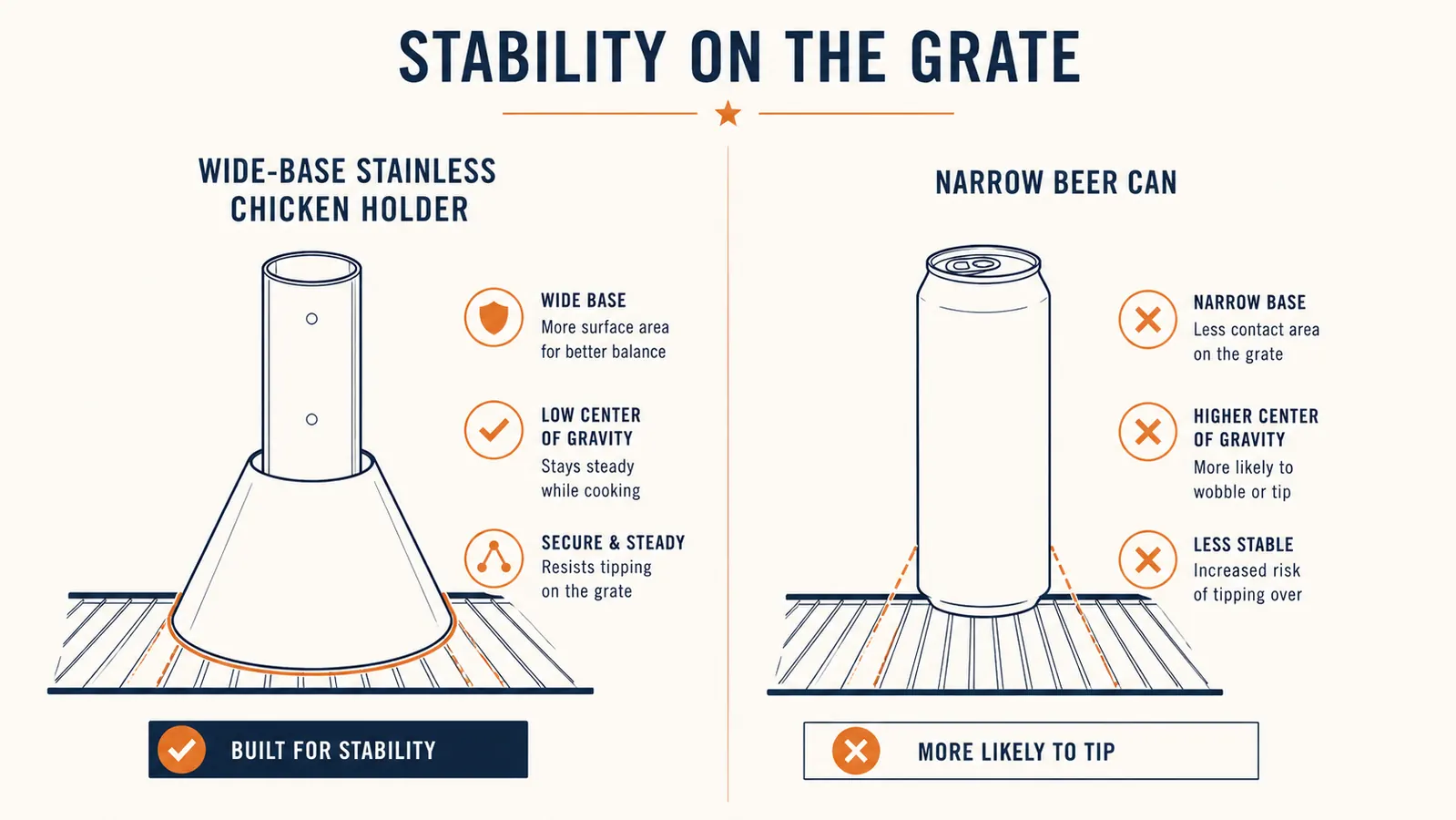
| Stability on the grate | Wide four-point base resists tipping, even on uneven grates | Narrow round base, tips easily on grates or coals |
| Liquid or flavor source | Built-in reservoir, fill it with beer, broth, cider, or juice | Whatever's left in the can after you take a few swigs |
| Heat safety | Cool carrying handle, lift the whole bird with one hand | Aluminum gets scalding hot, no handle, real burn risk pulling it off the grate |
| Cleanup | Dishwasher safe, rinses clean in seconds | Sticky, dented can, straight to the recycling bin |
| Reusability | Same stand, used again every cookout for years | Single use, a fresh can every single time |
| Cook consistency | Wide base holds the bird upright through the whole cook, even with wind or a jostled grate | Can shifts or tips as the chicken shrinks and drippings render out |
| Cost over a grilling season | One purchase, check today's price, covers years of cookouts | Technically free if you're already drinking one, but you're opening a fresh can for every cookout regardless |
| Best for | Regular grillers who want a repeatable, safe setup | One-off cookouts, tradition, no extra gear on hand |
Where Koohere Wins
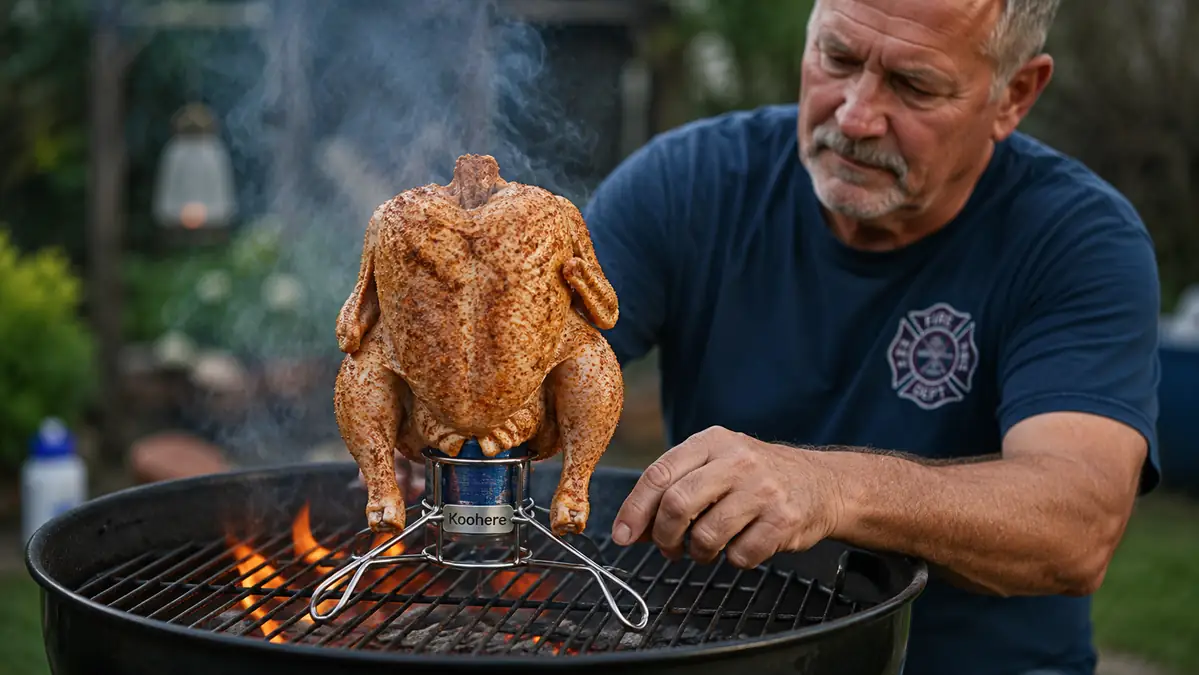
The base is the whole story, honestly. A beer can has a curved bottom about two inches wide, and once you slide a raw chicken down over it, all that weight is balanced on a surface not much bigger than a silver dollar. Any bump against the grate, any gust of wind if you're grilling outside on a breezy coastal evening like I usually am, and that can can lean. I've watched a can tip a good twenty degrees mid-cook and had to catch the whole thing with a spatula before it went over completely. The Koohere holder has a wide stainless steel base with real legs planted on the grate, so the bird sits low and steady the entire cook. I've grilled through some genuinely gusty afternoons on my back porch since I switched, the kind where the flames were leaning sideways, and the chicken never so much as wobbled.
Then there's the safety piece, and this is the one that matters most to me given what I did for a living. A beer can straight off the grill is scalding, there's no handle, nothing insulated to grab, so pulling a fully cooked chicken off the grate usually means wrestling it with tongs in one hand and an oven mitt gripping the hot can in the other, hoping the whole thing doesn't slide apart over the coals. The Koohere holder has a stay-cool handle built right into the design, so I lift the finished bird straight off the grate and carry it to the cutting board like I'm carrying a casserole dish. No juggling, no scalded fingers, no chicken landing skin-side down in the dirt because the can slipped out of the tongs at the worst possible moment. That last one happened to me exactly once with the can method, and once was enough.
The flavor side surprised me too. A beer can only holds whatever's left in it after you've had a couple sips, usually somewhere around half a can of whatever's in the cooler that day. The Koohere holder has an actual reservoir built into the stand, and I've filled mine with everything from a full can of beer to apple cider, chicken broth with garlic and rosemary, and even a splash of bourbon with brown sugar for a fall cookout. All of that steam works its way up through the cavity as the bird roasts, and I genuinely think the chicken comes out juicier and better seasoned from the inside than it ever did riding on a half-empty can. It's a small thing that turned into my favorite part of the whole setup.
And the math evens out fast once you actually grill more than a couple times a season. I've had my Koohere holder for a year now, it's been through easily thirty cookouts, gets rinsed off or run through the dishwasher after each one, and it still looks close to new sitting on my grill cart. The beer can method feels free since you're just grabbing something from the cooler, but you're buying that six-pack or cracking a fresh can every single time regardless of whether you were planning to drink one. Check today's price on the Koohere holder before your next cookout and you'll see it pays for itself in convenience alone within a handful of uses, long before you even get to the safety and stability side of the argument.
There's also a consistency angle that took me a while to notice. Because the Koohere holder keeps the bird perfectly upright and centered over the same spot on the grate the entire cook, the heat hits the whole chicken evenly, and I've had far fewer nights where one thigh finished at a safe internal temperature while the other side was still pink near the bone. With the can, once that base starts to lean even a little, part of the bird drifts closer to the coals than the rest, and you end up with uneven cooking that a meat thermometer catches too late to fix without pulling everything back off the heat. Small adjustment, big difference in how the chicken actually turns out when you carve it.
Where the Beer Can Method Wins
I'll give the can its due, because an honest comparison has to. If you're at a buddy's place, or you're camping and forgot to pack any specialty gear, the beer can method needs exactly nothing you don't already have in the cooler. No stand to remember, no extra piece of equipment taking up space in the truck. You crack a can, pour out or drink half of it, and you're roasting a chicken within five minutes. That kind of spontaneity has its place, especially for a spur-of-the-moment cookout where showing up with a stainless steel chicken stand would honestly look a little over-prepared.
There's also the nostalgia factor, and I won't pretend that doesn't count for something. Beer can chicken is one of those backyard traditions that gets passed down, the kind of thing my dad did on a rusty kettle grill when I was a kid, and there's a novelty to it that a stainless steel stand just doesn't have. If you're cooking for a crowd that gets a kick out of seeing a chicken perched on a can, or you only fire up the grill for whole chicken a couple times a year and don't see yourself doing it often enough to justify a dedicated tool, the can still gets the job done. It just asks you to accept more tipping risk, more scalded fingers at the finish line, and less control over what flavor is actually steaming into the bird while it cooks.
And if we're being honest about cost for the occasional griller, there's real appeal in not buying anything extra at all. If whole chicken on the grill is a once-a-summer thing for your family, spending anything on a dedicated stand can feel like solving a problem you don't have often enough to justify the drawer space. That's a fair call. Just know going in that you're trading a few dollars saved for a real chance of a scalded hand or a tipped bird landing in the coals, and weigh that against how much you'd actually mind either one happening at your next cookout.
Stop babysitting a can that might tip the second you turn your back.
The Koohere stainless steel chicken holder gives your bird a wide, stable base, a cool carrying handle, and a reservoir you can fill with whatever flavor you want, not just whatever's left in the can. Check today's price before your next whole chicken cookout.
Amazon Check Today's Price on Amazon →
Who Should Buy Which
If you grill a whole chicken more than once or twice a season, or if you've ever had a beer can tip on you mid-cook the way I have, get the Koohere holder and stop thinking about it. The wide base alone solves the biggest problem with the can method, and the cool handle means you're not gambling with a burn every time dinner's ready to come off the grate. I keep mine hanging on my grill cart right next to my tongs now, it's earned a permanent spot there instead of a seasonal one.
If you're grilling a whole chicken once this summer, you're at someone else's place with no gear of your own, or the nostalgia of the can trick is genuinely part of the fun for you, there's nothing wrong with sticking to the classic method for that one cookout. Just keep a close eye on the can once the bird starts cooking down and the weight shifts, and use real tongs, not your hand, when it's time to pull it off the grate. That's the one habit that's kept me from getting burned on the rare occasions I still do it the old way.
My honest take after running both through a full year of cookouts, coastal wind and all: the Koohere holder is the one I reach for by default now, and the beer can only comes out when I'm somewhere without my own gear or a grandkid wants to see the old trick done the way my dad used to do it. Either way, the actual grilling technique underneath, indirect heat, a covered grill, and a chicken checked for doneness with a real thermometer rather than a guess, matters more than which stand or can it's balanced on. Get that part right first, and either method will get you a good dinner.
I stopped babysitting a wobbling can the day I set a chicken on a base wide enough to actually hold it. That's the whole trick nobody tells you about.
Give your next whole chicken a base that won't tip over on you.
The Koohere holder has held up through a full year of my cookouts, rain or shine, gusty porch or not. Check today's price and see for yourself.
Amazon Check Today's Price on Amazon →