
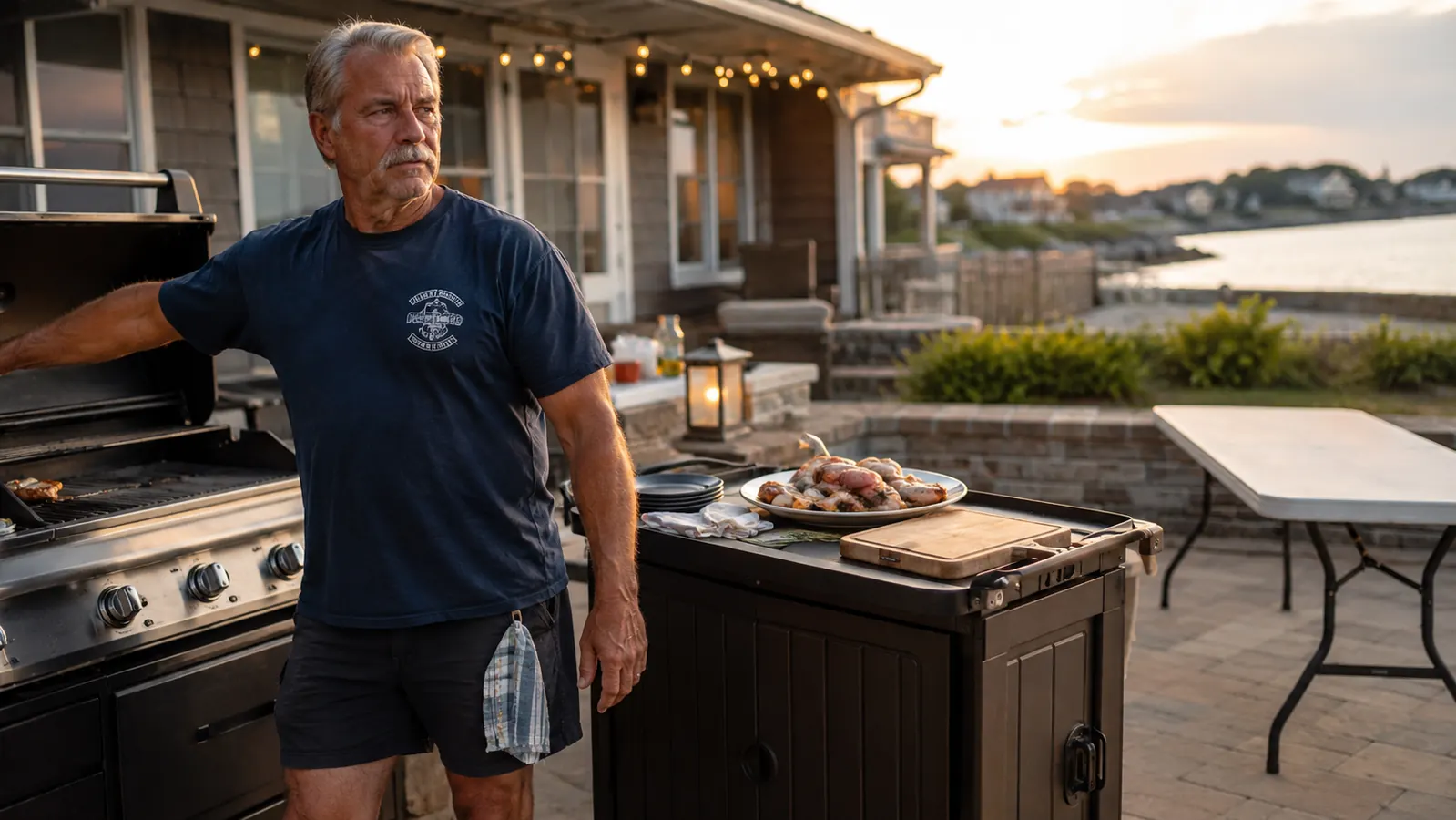
For about twenty years, my grill-side setup was a folding plastic table that lived behind the water heater in the garage and came out every single Saturday morning smelling faintly of mildew. It did the job, more or less, until my son-in-law Mark showed up two summers ago with a housewarming gift I hadn't asked for and honestly didn't think I needed, a Keter outdoor rolling prep cart. I want to walk you through exactly how that cart stacks up against the folding table I used for two decades, because the honest answer isn't as simple as 'the cart wins on everything.' It doesn't. But for a grill station you actually use every week, it wins where it counts, and it took me one season to admit Mark had been right.
Short answer up front: if you're setting up a permanent station beside a gas grill or a kettle, the Keter cart earns its keep fast, mostly because it solves problems the folding table never could, wobbling, no storage, nowhere to put a trash bag. If you host twice a year and need something that folds flat and disappears into a closet, the folding table still has a place in your garage. Below is the side by side I wish I'd had before Mark spent his own money proving the point for me.
| Keter Rolling Cart | Folding Table | |
|---|---|---|
| Price | Check today's price, one purchase built to live outside for years | Mid-range, but often replaced every few seasons |
| Material | Weatherproof resin, rust-proof, UV-resistant, wood-look finish that doesn't rot | Painted steel legs and a thin plastic top that chips and rusts at the hinges |
| Storage | Enclosed cabinet plus a bottom shelf, holds charcoal bags, paper towels, and tools out of sight | None, it's a flat surface with legs, nothing goes underneath but shade |
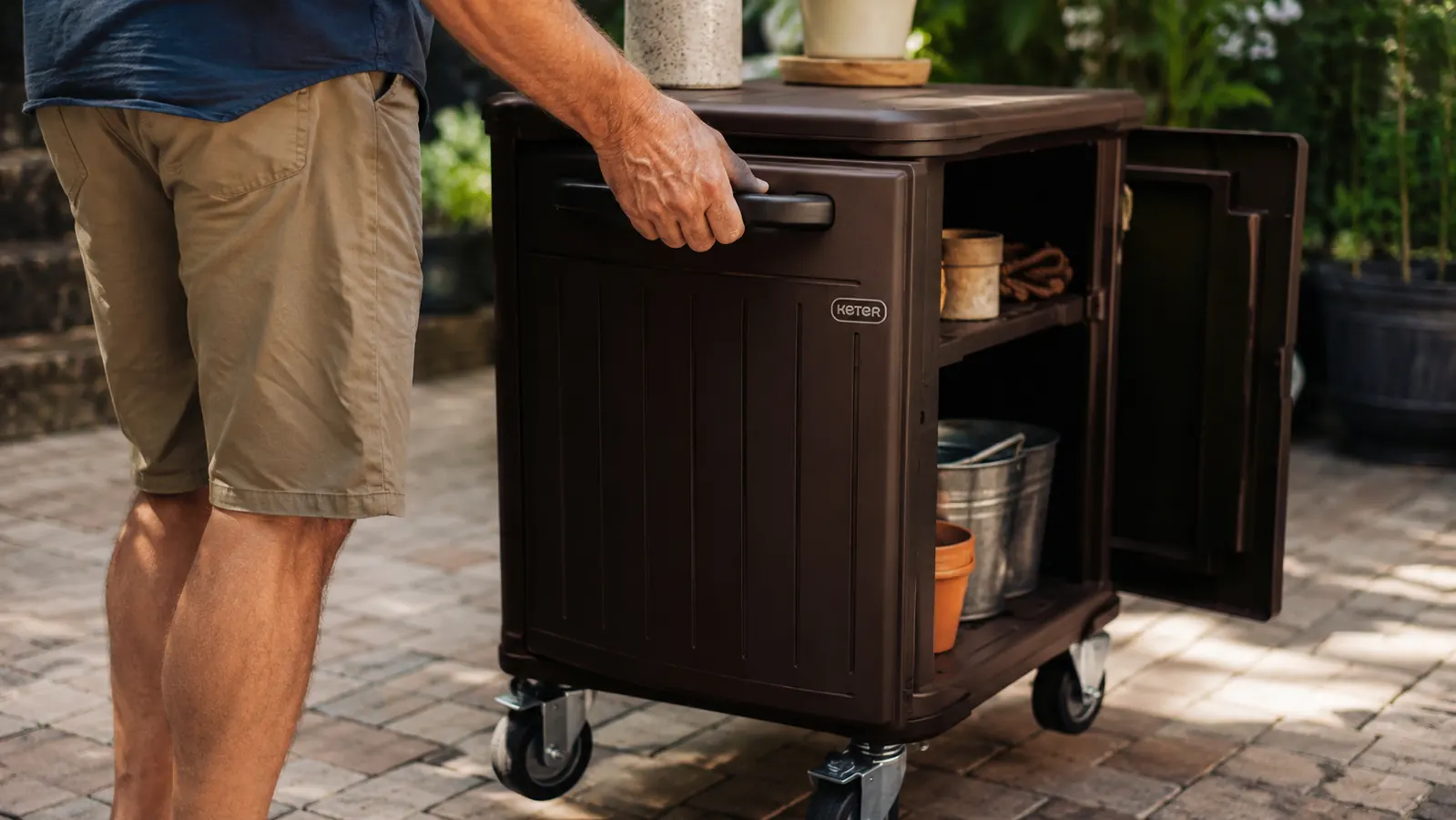
| Mobility | Four wheels, two with locking brakes, rolls across pavers, grass, and gravel | Carry by hand only, no wheels, awkward with anything on top |
| Weather resistance | Left outside year round, handles salt air, rain, and sun without rusting or warping | Needs to come inside between uses or the legs start rusting at the joints |
| Stability | Wide, low-set base, doesn't rock or flex under a full sheet pan of raw chicken | Center hinge flexes under weight, tips easily on uneven grass or pavers |
| Setup time | Roll it out and go, it's a permanent station, nothing to unfold | Unfold and lock each leg before use, fold everything back up after |
| Extra features | Built-in bottle opener, garbage bag ring, towel bar, and a bar rail on top | None, it's a bare tabletop |
Where the Keter Rolling Cart Wins
The first thing that changed was stability, and this one matters more than people realize until they've watched a platter slide off a rocking table. My old folding table had a center hinge that flexed every time I leaned on it with a full tray, and I lost more than one rack of ribs to gravity because of it. The Keter cart sits low and wide on four wheels, two of which lock, so it doesn't rock when Danny leans on it reaching for the tongs, or when my grandson Eli decides the bottom shelf is the perfect spot to stash his water gun mid-cookout. A grill station that actually holds still sounds like a small thing until you're the one who used to work around a wobble for two decades.
The second thing is what the cabinet does for the whole layout of a cookout. With the folding table, everything I needed lived in a cooler bag, a tackle box of grill tools, or three separate trips back into the kitchen. The Keter cart has an enclosed cabinet and an open bottom shelf, so charcoal, extra propane fittings, paper towels, and my meat thermometer all have a home right at arm's reach. I stopped making the walk back inside every time I needed something, which sounds minor until you count how many trips a two-hour cookout used to cost me. My wife Donna noticed it before I did, she said grill night finally stopped pulling me in and out of her kitchen every fifteen minutes.
Then there's the weather side of it, and out here four miles off the water outside Wilmington, that's not a small consideration. A painted steel folding table starts rusting at the hinges within a couple seasons if you leave it out, and mine spent enough nights forgotten on the patio that the legs eventually seized up and had to be forced open. The Keter cart is built from the same weatherproof resin Keter uses in their deck boxes and storage sheds, so it sits under the porch overhang year round without me babying it. No rust bleeding through, no swollen wood, no hinges that need WD-40 before they'll fold. It just rolls out looking the same as the day Mark brought it over.
The small touches add up too. There's a bottle opener built into the side, a ring for hanging a garbage bag so I'm not chasing chicken bones and used napkins across the yard, and a towel bar that keeps my rag from ending up draped over the grill lid where it always used to end up. None of those things sound like much on their own, but together they turn a folding table into an actual station, the kind that doesn't need three trips inside to function. My fire captain buddy Big Earl came over for a Sunday cookout last fall, looked the cart over, and asked where I got it before he'd even had a beer. That's usually a good sign.
There's also a bar rail across the top edge that I didn't think much of when Mark first pointed it out, but it's turned into the spot where drinks and condiments line up during a cookout instead of sliding around loose on a flat table. When Mark and my daughter host their own get-togethers now, he tells me the top of that cart is the first thing guests find, plates on one side, drinks lined up along the rail, no one hunting around the kitchen for a bottle opener because there's one built right into the cart. It's a small design choice, but it's the kind of thing you only appreciate after you've spent twenty years without it.
Where the Folding Table Wins
I won't pretend the folding table has nothing going for it, because an honest comparison has to give it its due. It cost me a modest amount years ago, and it folds down to a few inches thick, which means it lives flat behind the water heater and takes up almost no room. If you host maybe twice a summer, or your family tailgates more than it backyard grills, that flat-fold portability is real. You can toss it in the trunk next to the cooler without thinking twice, and there's no assembly, no wheels to worry about, nothing to store when the season's over.
It's also lighter, plain and simple. One hand, no strain, up the porch steps and back down again. The Keter cart, loaded or empty, isn't something you're carrying up a flight of stairs, it rolls, and it rolls well across my paver patio and the grass beyond it, but it's not a grab-and-go item the way a folding table is. If your setup changes location every time you cook, or you don't have a covered spot to leave a cart parked between cookouts, the folding table's simplicity still wins that specific fight. My neighbor Frank still keeps one in his truck bed for tailgates, and for that use case, I'm not going to argue with him.
Cost is the other honest point in the table's favor. If you're just starting out with your first grill and you're not sure yet how often you'll actually use it, spending real money on a dedicated cart before you know your own habits doesn't make much sense. A folding table lets you test the waters for a season or two without much investment, and if it turns out you're only firing up the grill for the Fourth of July and one Labor Day cookout, you never have to think about upgrading at all.
A wobbly table doesn't just annoy you, it spills things. At a firehouse cookout that usually means somebody's boots.
Stop dragging a card table out of the garage every time you fire up the grill.
The Keter outdoor rolling prep cart gives you a permanent, weatherproof station with real storage underneath, wheels that lock, and a surface that doesn't flex under a full platter. Check today's price before your next cookout.
Amazon Check Today's Price on Amazon →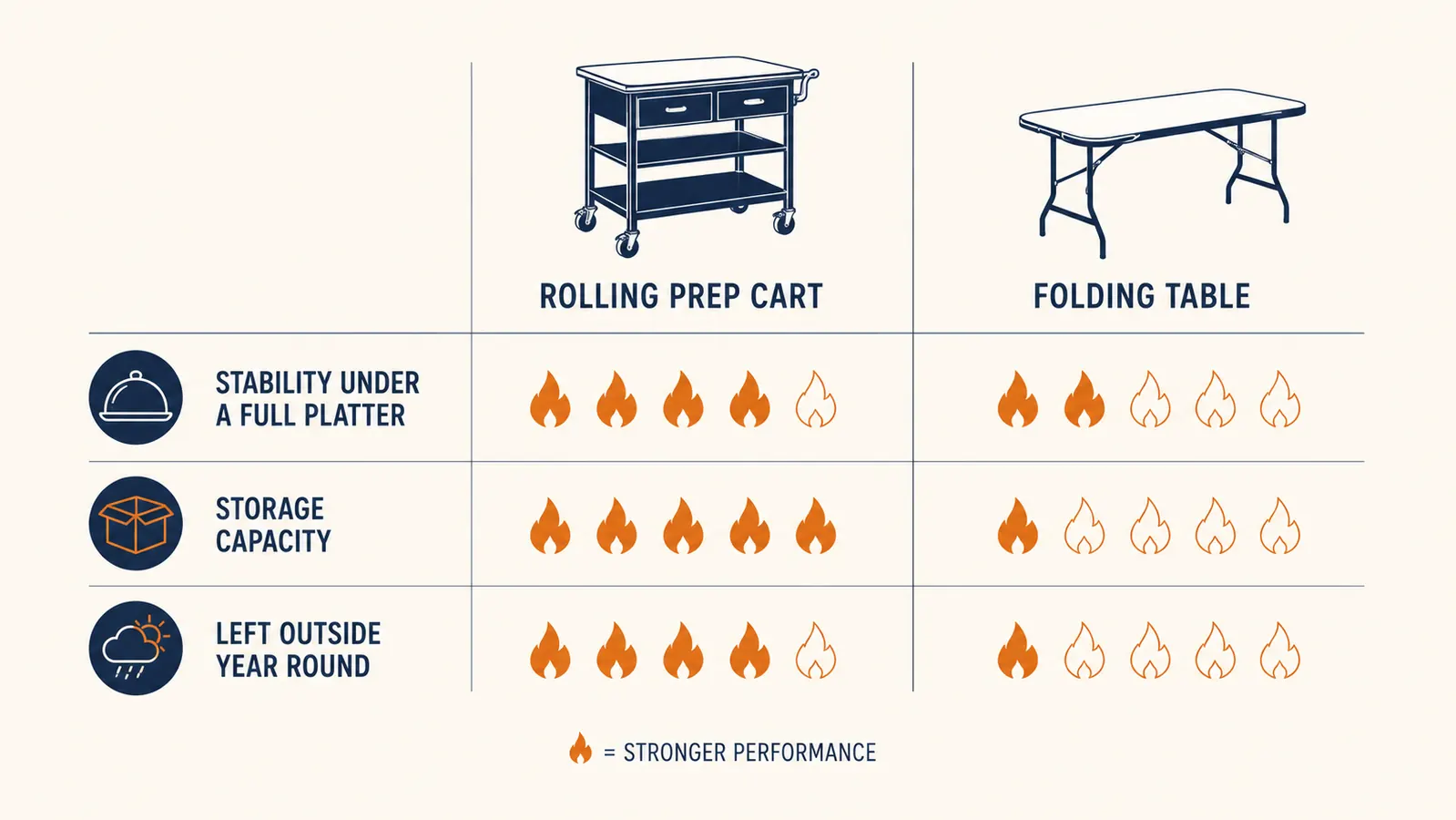
Assembly, Setup, and How It Fits the Real Backyard
Assembly took me a little under an hour, working alone on a Saturday morning with the hex key and instructions that came in the box. Donna held a couple of the resin panels steady while I got the bolts started, but I could have managed solo if I'd had a second chair to lean pieces against. Compare that to a folding table, which takes zero assembly but also gives you nothing, an hour spent once against a decade of use isn't much of a trade. The wheels were the part I appreciated most once it was together, two of the four lock in place, so I can park the cart exactly where I want it beside the grill and it stays put, no creeping downhill on my slightly sloped patio the way I half expected.
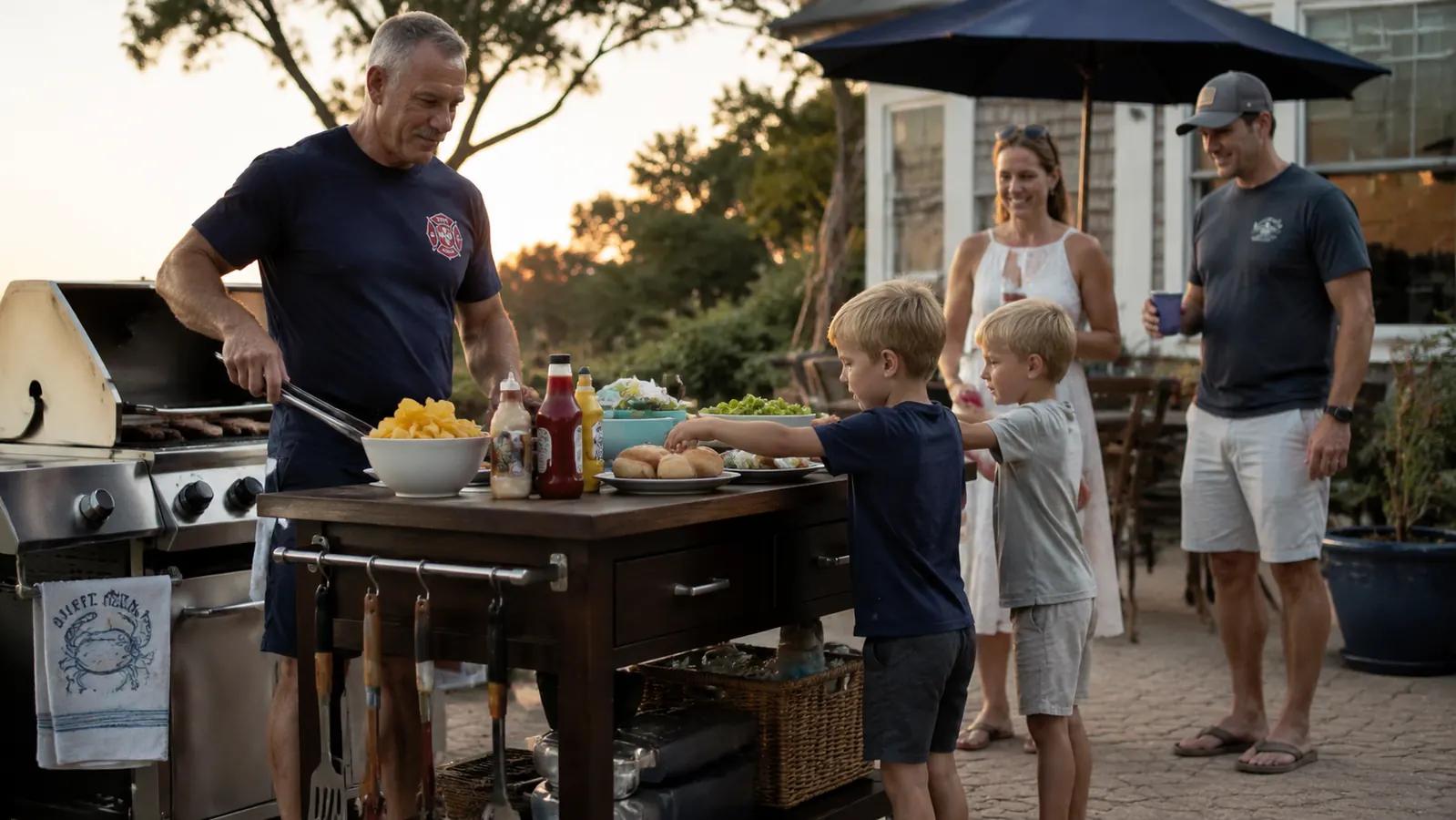
Where it really earns its keep is in how it fits into a real cookout rhythm. The cabinet holds a full bag of charcoal, a roll of paper towels, and my digital thermometer without any of it getting rained on or blown off in a gust. The open shelf underneath is where the cooler-adjacent stuff lives, extra tongs, a spare set of grill mitts, the bug spray nobody remembers until the mosquitoes show up at dusk. When my grandsons Eli and Wyatt come over, they know the top of the cart is where the sides and buns sit, and they've stopped asking me every five minutes where things are, because now there's an actual place for them to be.
Who Should Buy Which
If your grill station is a permanent fixture in your backyard, something you use most weekends and want to stop rebuilding from scratch every time, get the Keter cart and stop patching the problem with a table that wasn't built for this job. It fits into a real routine, holds still under a loaded platter, and after two seasons of coastal weather mine still rolls and locks the way it did the day Mark put it together. My son Danny finally bought one for his own place last spring after using mine at enough family cookouts, and he told me the storage alone changed how he preps for a crowd, he's not running back inside for a serving spoon halfway through grilling.
If you're tight on storage space, or you cook out only a handful of times a year, or your setup genuinely needs to travel in a trunk, the folding table you've already got will get the job done fine. Just don't expect it to hold up the way a purpose-built cart will if it ends up living outside longer than planned, that's exactly how mine wore out its hinges years before I finally replaced it. My honest take after running both through a full cookout season: the folding table is a stopgap, the Keter cart is the actual station, and once you've rolled one into place instead of unfolding legs on uneven ground, it's hard to go back to card-table cooking.
Give grill night a station that doesn't fold, wobble, or rust out on you.
The Keter rolling prep cart has held up through two full coastal seasons on my own patio, storage, stability, and all. Check today's price and see for yourself before your next backyard cookout.
Amazon Check Today's Price on Amazon →