

I want to level with you before I tell you why I still reach for the Koohere chicken holder most weekends. When the padded envelope showed up at a budget price point, my first reaction wasn't excitement, it was suspicion. Twenty-two years on a fire truck taught me that cheap metal and high heat don't always get along, and I figured this stainless stand from a brand I'd never heard of before searching for it on Amazon at eleven o'clock one night was going to end up in the give-away pile with everything else that seemed like a good idea in the moment. I was wrong about that. But I was also wrong to expect it would be perfect out of the box, and that's the part most reviews skip right past.
This is the honest version, the one I'd actually give my neighbor Frank if he leaned over the fence and asked whether it's worth the modest price and a slot in his utensil drawer. Not the highlight reel. The small stuff nobody mentions until you've used it a dozen times and started noticing the same little annoyances show up in the same places, cook after cook.
I've read enough Amazon reviews over the years to know the pattern. Somebody buys a cheap kitchen gadget, it works on the first try, and they leave five stars before they've used it more than once or twice. I don't blame them, that's just how most people shop. But a chicken holder that only gets used a handful of times a year isn't the same test as one that's been on my grill grate more than two dozen times since spring, through beer spills, a couple of rushed cleanups, and one very skeptical retired fire captain looking for a reason to tell me I wasted my money. This review is what's left after all of that.
The Quick Verdict
The Koohere holder earns its keep, but it's not the flawless upgrade the five-star reviews make it sound like. Read past the headline before you buy.
Amazon Check Today's Price →Curious if it's really worth the hype, or just the price?
The Koohere stainless chicken stand fixes the wobble problem for a budget price. Here's the honest breakdown of what it actually gets right, and where it falls short.
Amazon Check Today's Price on Amazon →How I Tested It
I didn't buy the Koohere holder to write about it. I bought it because my son Danny was coming down from Raleigh for a long weekend and I wanted to try roasting a chicken standing up instead of laying it flat like I always had. That first cook, I set it up on my gas grill exactly the way the little insert card suggested, filled the reservoir with a can of beer, and put the bird on. Danny stood there with his arms crossed the whole time, waiting for it to tip over the way things usually do when I try something new on that grill. It didn't tip. That surprised both of us.
Since then I've put somewhere around two dozen cooks on it, split fairly evenly between the gas grill and my offset smoker, plus one memorable Fourth of July where my old friend Big Earl, a retired fire captain who's seen every gadget come and go through a firehouse kitchen, picked it up off the counter and turned it over like he was inspecting evidence. Big Earl doesn't trust anything that costs less than a proper cast iron skillet, and he told me flat out he expected the legs to bend the first time a hot bird sat on it wrong. They haven't, not once, but I'll tell you exactly what has gone sideways further down.
I tested it the way I test most things I write about, which is by not being careful with it. I've set it directly on a hot grate without letting it warm up first, I've dropped it into the sink still hot more than once, and I left it out on the porch through a stretch of humid coastal summer weather that turns a lot of cheap metal into rust within a season. It survived all of that. What it hasn't survived is my own tendency to lose track of it in a drawer full of other grilling gear, which turned out to be a bigger problem than I expected.
I also ran it against birds of different sizes, since most reviews only ever mention the one chicken they happened to cook that week. A smaller four-pound fryer sat on the Koohere holder without much drama, plenty of clearance and no real balance issues. A bigger seven-pound roaster was a different story, top-heavy enough that I kept one hand near the grill the whole first twenty minutes just in case, even with the legs trussed. If you're routinely buying the bigger birds for a crowd, keep that in the back of your mind. This stand is built around an average five to six pound chicken, not the biggest one at the store.
What the Five-Star Reviews Don't Mention
Scroll through the reviews on Amazon and you'll see a lot of five-star praise about how it holds a chicken upright, which is true and which I don't dispute. What you won't find much of is anyone talking about the reservoir cup, which is genuinely on the small side. A standard twelve-ounce can of beer does not fit in there without spilling once it starts to simmer. I found that out the hard way on Danny's visit, watching beer bubble up over the rim and drip down onto my burner tubes, which is not a smell you want lingering on your grill for the next three cookouts.
Nobody mentions the legs splaying under a heavy bird either, at least not the six-pound roasters I usually buy from the grocery store near my house. The first time I used it, I set the chicken on with the legs loose and untied, and by the time it came off the grill one leg had swung out far enough that the bird was leaning noticeably to one side. It hadn't tipped completely, but it wasn't the picture-perfect upright roast the product photos show either. I truss the legs with butcher's twine now before every cook, a two-minute fix, but it's a step the packaging never tells you to take.
The handle is another quiet miss. It works fine, it stays reasonably cool, but it's shaped in a way that doesn't sit comfortably in a gloved hand, and anyone who grills seriously knows you're not lifting a hot bird off a grate bare-handed. I've had to shift my grip mid-lift more than once because the handle's angle fights against a thick silicone glove instead of working with it. Small thing. But it's the kind of small thing that only shows up after you've used it, not while you're reading a product listing.
One more thing worth saying plainly. A lot of the reviews assume you're filling that reservoir with beer, because that's the name everybody still uses for this style of stand. I've had better luck with apple juice cut with a little water, partly because it fits the smaller cup better without foaming up the way beer does over direct heat, and partly because Big Earl pointed out that a full can of beer sitting that close to a burner for over an hour is just asking to boil dry and scorch. He wasn't wrong. I still use beer sometimes for the flavor, but I watch it closer than I used to, and I don't fill it all the way anymore.
The Drawer Space Problem
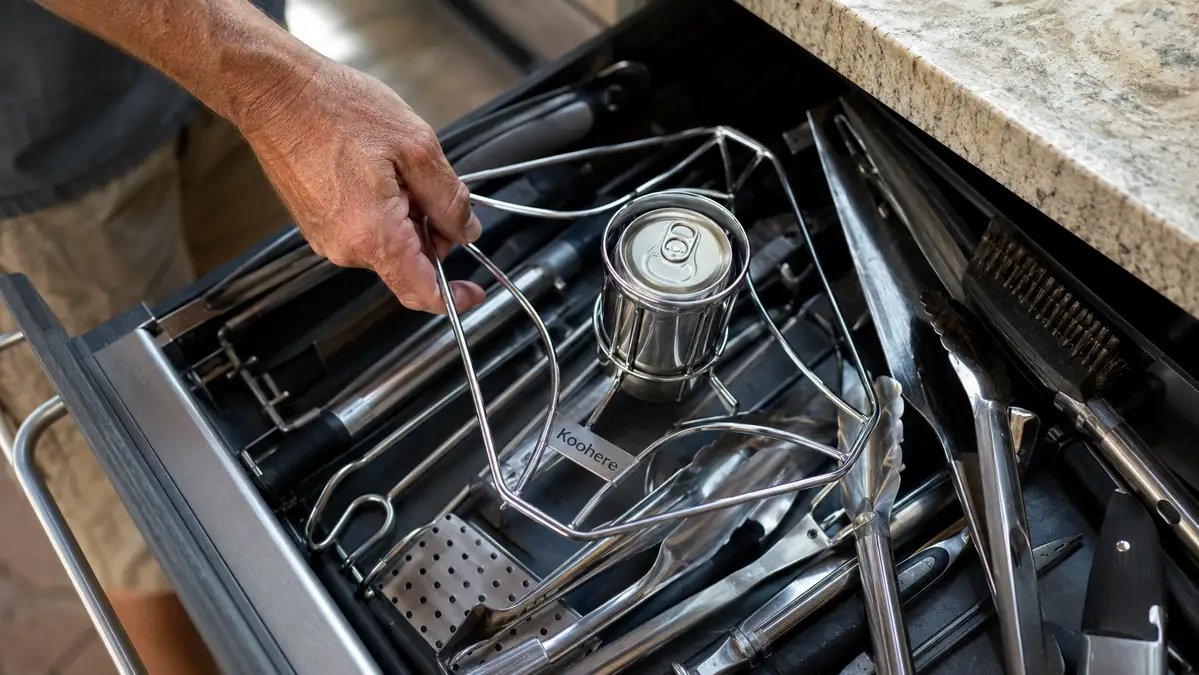
Here's the part of the title that isn't just clever wordplay. This thing takes up more room than you'd guess from the photos. It doesn't fold flat, it doesn't nest inside anything else, and the three splayed legs make it an awkward shape to store next to tongs and spatulas. In my kitchen, it lives in the bottom drawer with the rest of my grilling gear, and it has become the one item in that drawer that snags on everything else when I go digging for a meat fork at the wrong moment. Donna has mentioned it more than once, usually when she's trying to find something else in that same drawer and comes up with a stainless steel chicken stand instead.
I ended up solving it the cheap way, with a gallon zip-top bag that keeps the legs from catching on the drawer track, which works fine but is one more thing to remember. If you've got a pegboard or a hook system in your garage or grill shed, you could hang it by the handle and skip the drawer problem entirely, and honestly that's what I'd recommend if you're setting up storage for the first time rather than retrofitting an already-crowded drawer like mine.
Cleanup, Without Sugarcoating It
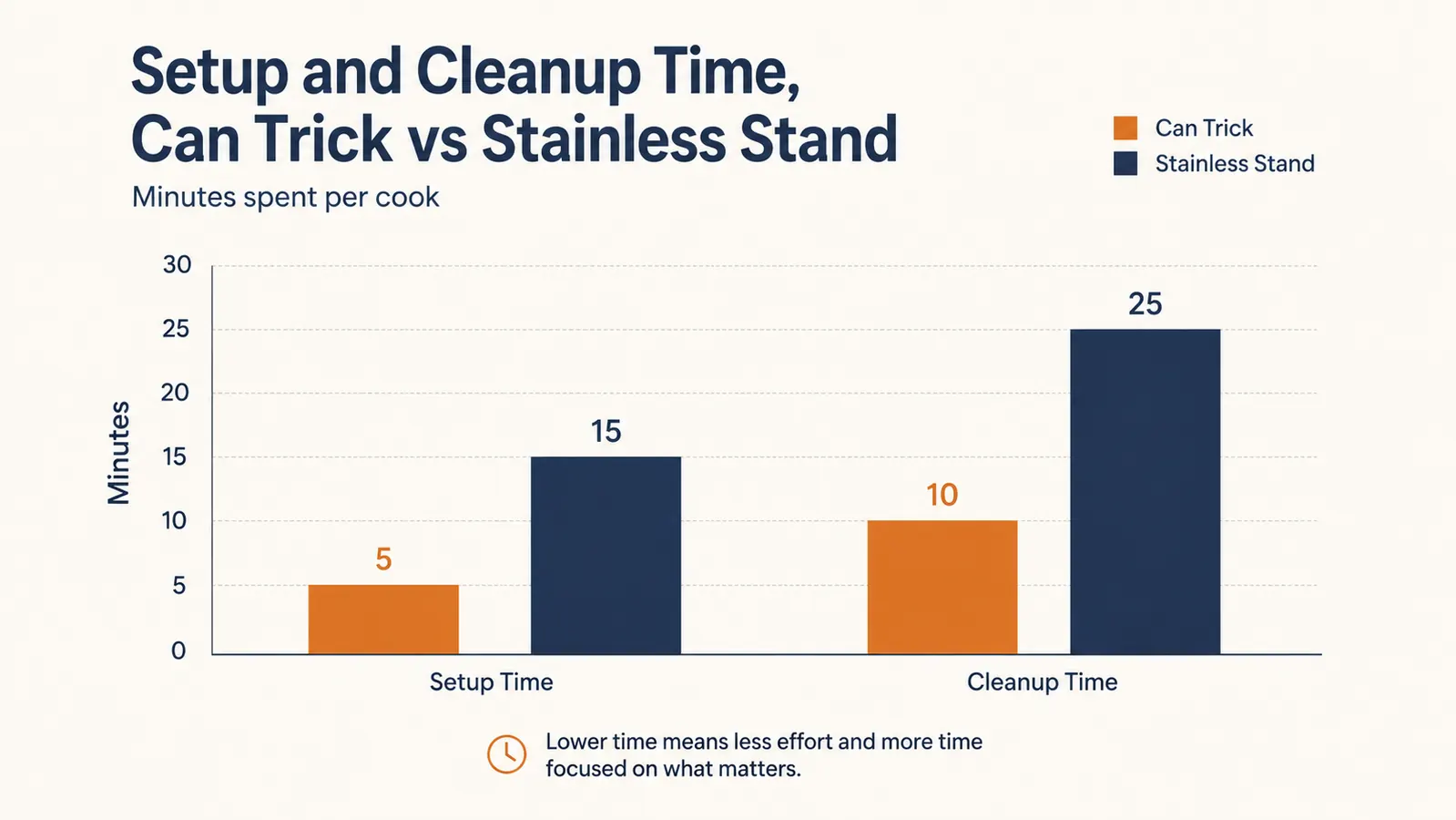
The listing says it's dishwasher safe. I ran it through my dishwasher exactly twice before I stopped, not because it damaged the stand, but because it came out with a chalky film along the base that took more scrubbing to remove than if I'd just washed it by hand in the first place. My dishwasher runs hard water through it same as most people's do near the coast, and stainless steel with tight seams around the leg welds seems to hold onto that film worse than a flat pan would.
Hand washing works better, but it's not a rinse-and-done situation either. Grease collects right where the legs meet the base, and if you let a cook or two go by without getting in there with a bottle brush, it builds up into something closer to a scrubbing project than a quick wipe. I keep an old toothbrush in the cabinet under my sink specifically for this stand now, which tells you something about how much attention those seams actually need.
I'll give it credit on the rust question, though, because that's usually where a cheap stainless piece falls apart on you. I left it out on an open porch shelf through a stretch of July and August so humid that the salt air alone has ruined tools of mine before, and it came through without a spot of orange anywhere on it, even down around the base where moisture tends to sit longest. That's real stainless doing its job. It's just not maintenance-free stainless, and anybody telling you otherwise hasn't scrubbed the leg welds after a greasy cook yet.
Is It Actually Worth Ten Dollars
Yes, but I want to be specific about why, because I think a lot of the glowing reviews oversell the reason. It's not worth it because it makes some dramatic difference in flavor, it doesn't. A chicken roasted standing up on the Koohere holder and a chicken roasted flat on a sheet pan, seasoned the same way, taste close enough that most people at your table won't notice a difference blind. What it's actually worth the money for is safety and consistency. I'm not lifting the grill lid every fifteen minutes worried a top-heavy bird is about to roll off a beer can and onto hot flame tamers, which happened to me more than once with the old method and which is exactly the kind of small kitchen disaster that used to be my day job to clean up after other people.
At the price point, I don't think there's much competition. I checked around before I bought it and most of the alternatives that looked sturdier were priced closer to twenty or thirty dollars for a heavier cast iron version, which is a fair amount more to spend on something that solves the exact same wobble problem. For under ten dollars, the Koohere holder does the job it claims to do. It just does it with a couple of rough edges nobody bothered to warn me about.
So here's where I land on it, plainly. If you go in expecting a flawless gadget because the star rating says so, you'll notice every one of the small annoyances I just walked through and feel a little let down. If you go in knowing what you're actually buying, a genuinely stable stand with a couple of rough edges, for less than the price of a fast food lunch, it's an easy yes. That's the honest math, not the five-star version.
What We Liked
- Genuinely stable once the legs are trussed, hasn't tipped in two dozen cooks
- Costs less than most alternatives that do the same basic job
- Stainless steel held up fine through a humid coastal summer with no rust
- Works on gas grills, charcoal, and offset smokers without any modification
Where It Falls Short
- Reservoir cup is too small for a full twelve-ounce can without spillover
- Bulky shape takes up more drawer space than the listing photos suggest
- Dishwasher leaves a chalky film, hand washing the leg welds takes real effort
- Handle angle doesn't sit well in a thick grilling glove
It does what it says it does. It just doesn't tell you about the beer spilling over the burner tubes or the drawer fight every single time you go looking for tongs.

Who This Is For
If you're roasting a whole chicken more than once a month and you've had a close call with a wobbly beer can before, this is a cheap, low-commitment way to fix that problem. It's also a reasonable pick if you've got a pegboard or hook to store it on rather than a crowded utensil drawer, since that solves the one real inconvenience I've run into with it.
Who Should Skip It
If you're tight on kitchen storage and already fighting to close your utensil drawer, or if you roast a whole chicken rarely enough that the wobble was never really a problem for you, I wouldn't rush out for this one. And if you're expecting some noticeable flavor upgrade over roasting flat, temper that expectation now. The upgrade here is safety and stability, not taste.
Still want the stability without the guesswork?
Now you know the parts nobody mentions. If the tradeoffs work for your kitchen, the Koohere holder is still the cheapest fix I've found for a chicken that won't stop wobbling on a beer can.
Amazon Check Today's Price on Amazon →