
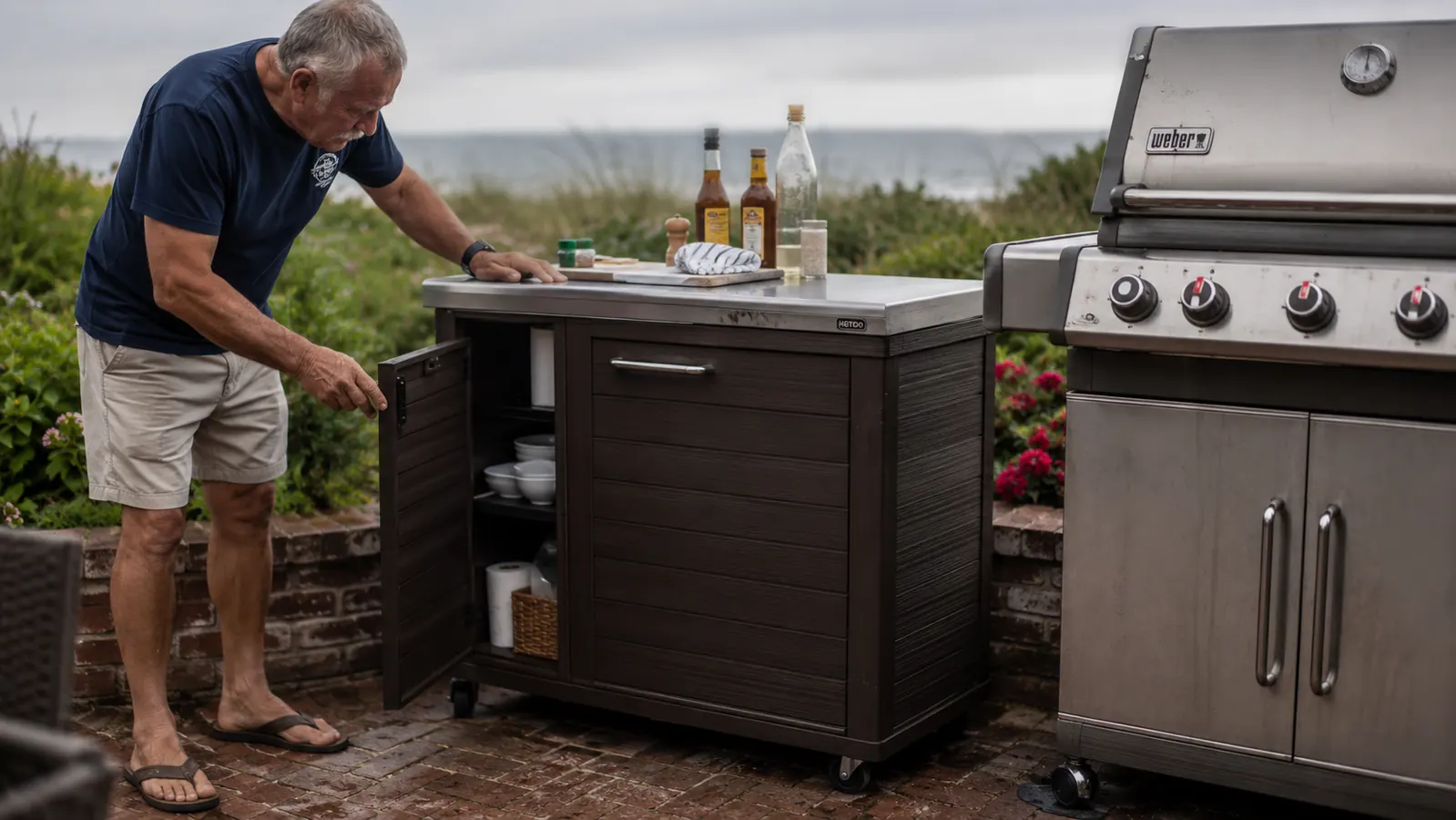
I want to get one thing out of the way before I say anything nice about this cart. My son-in-law Mark gave me the Keter outdoor rolling prep cart as a surprise gift last spring, after watching me juggle a cutting board, three bowls, and a pair of tongs on top of a cooler at Eli's birthday cookout. I unboxed it expecting the same glowing experience the Amazon reviews promised. What I got instead was a genuinely useful piece of gear with a handful of rough edges nobody mentioned to me first, and that's really what this review is for. If you're the kind of buyer who reads the five-star reviews and still wonders what they're not telling you, keep reading.
I'm Curtis Boone. Twenty-two years in the fire service down here near Wilmington taught me to distrust anything that looks too clean on paper, so when a product review makes something sound flawless, I get suspicious. This isn't going to be that kind of review. The Keter cart has earned a permanent spot next to my grill, but I'm going to walk you through the parts that annoyed me, the parts that surprised me, and the parts the marketing photos gloss right over.
The Quick Verdict
A solid, genuinely useful rolling prep station once it's together, but the assembly process and a few small design choices deserve more honest attention than the star ratings suggest.
Amazon Check Today's Price →Before you add this to cart, know what the box actually asks of you.
It's a good cart once it's set up. Getting there takes a little more patience than the listing lets on. Here's the honest rundown before you decide.
Amazon Check Today's Price on Amazon →How I've Used It
The cart has been outside next to my grill since Mark handed it to me back in April, and it's seen every cookout since, from small Sunday dinners with just Donna and me to full backyard gatherings with Danny, Mark, and the grandkids running around underfoot. I use the top for cutting boards and platters, and the enclosed cabinet underneath has become the default home for mixing bowls, foil, and my spare set of tongs.
That part of the experience has been genuinely good, and I don't want the rest of this review to bury that. But a review that only talks about how happy you are six months in isn't the full picture, and I think buyers deserve the parts that happened along the way too, especially the first two weeks, which were rougher than I expected.
What the Amazon Photos Don't Quite Show You
The listing photos show a rich, warm dark brown finish that looks almost like stained wood from a certain angle. In person, under regular daylight, it reads more like a flat blackish-brown, closer to dark chocolate than the honey-toned brown in some of the product shots. It's not a bad look. My patio furniture is mostly black and gray, so it actually fits fine. But if you're trying to match a specific outdoor color scheme, order it expecting the darker, flatter version, not the warmer tone the photography suggests.
The cart also looks a bit more substantial in the photos than it feels the first time you put your hand on it. It's not flimsy, and I'll get into how it's held up in a minute, but the resin panels have a lighter, hollower feel when you knock a knuckle against them than the images imply. Keter isn't hiding anything, it's just that photography tends to flatten out texture and weight, and a rolling resin cart is never going to feel like the steel equipment I spent two decades around at the firehouse.
One more thing nobody mentioned before I bought it, there's a faint plastic smell for the first week or so, stronger right out of the box and fading with time outdoors. It never bothered food sitting on top, but if you're sensitive to that kind of thing, let it air out in the garage or on the porch for a few days before you roll it into regular use.
The Assembly Nobody Warns You About
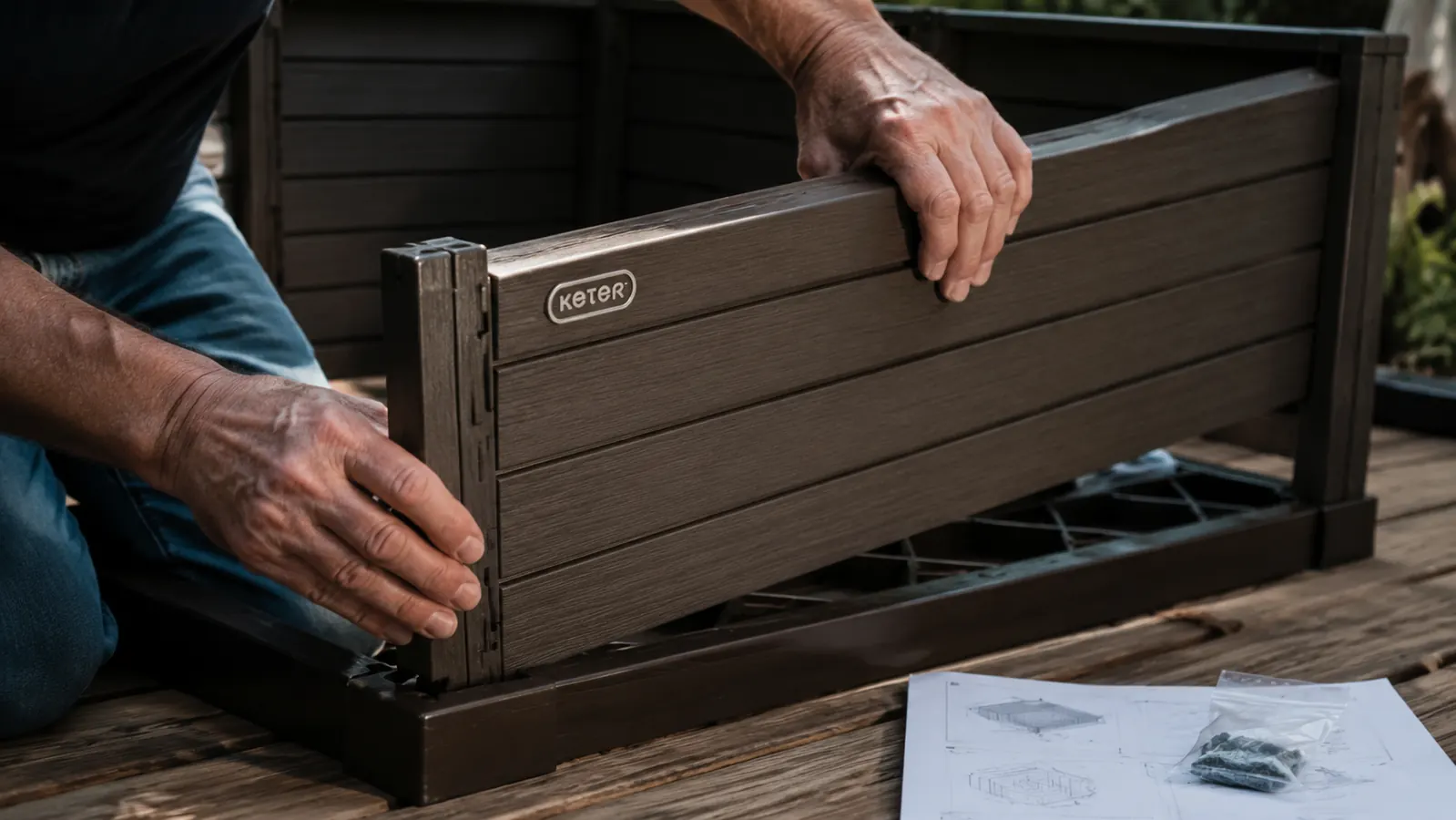
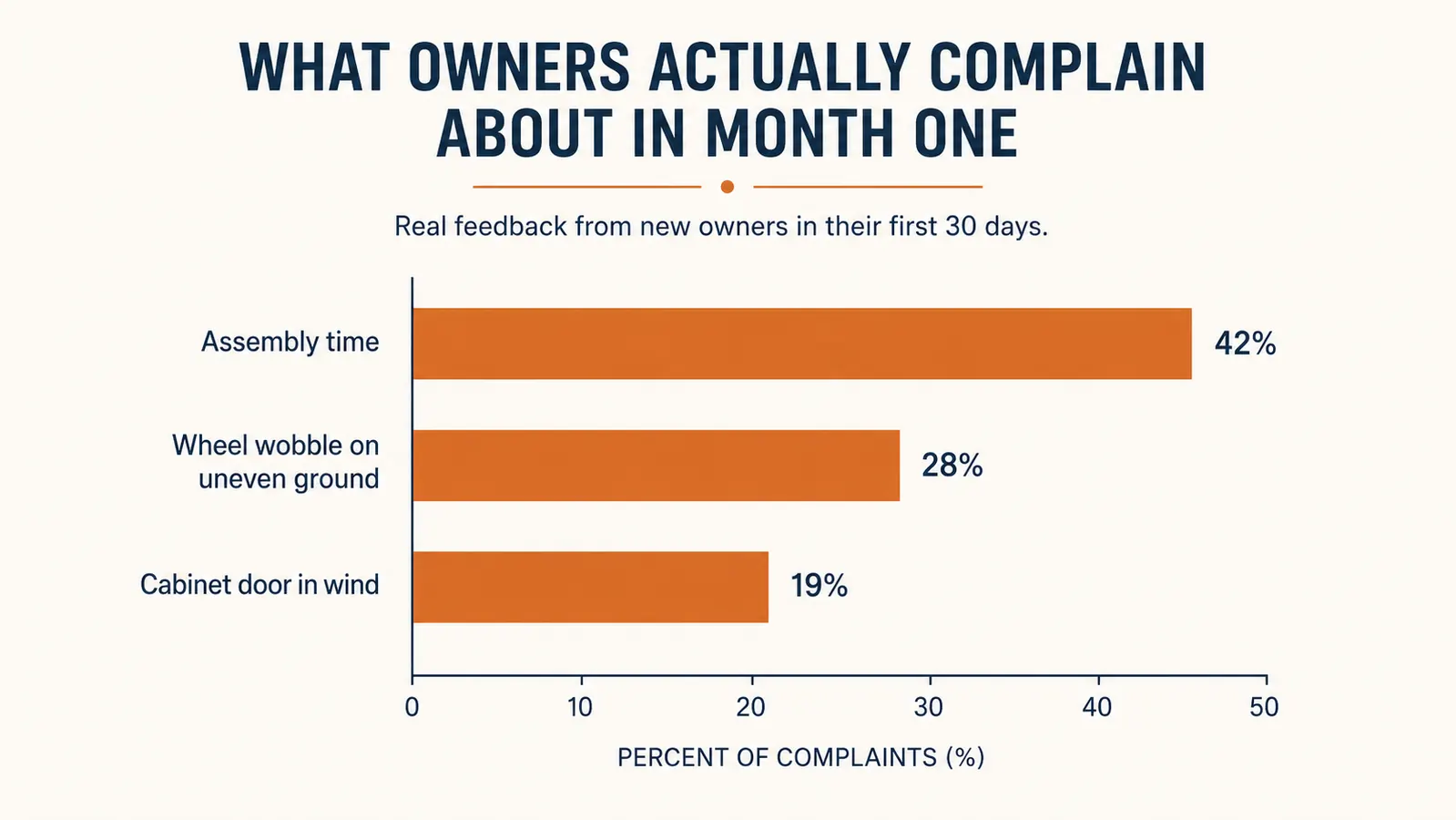
This is where I want to be the most honest, because it's where I felt most let down by the glowing reviews I'd read beforehand. The box says the cart goes together quickly with basic tools. Danny came over to help me put it together on a Saturday morning, and between the two of us, it took closer to an hour and a half, not the fifteen or twenty minutes some reviewers claim.
Part of that was our own fault. One bag of hex screws was mixed in with a bag meant for a different panel, and we spent a solid ten minutes trying to force the wrong size screw into a hole before we caught the mistake. Danny actually dropped one of the small screws straight through a gap in our deck boards, and we never did find it, had to substitute a spare from the leftover hardware bag. If you're assembling this alone, do yourself a favor and sort every bag of hardware onto a towel before you start, rather than opening them one at a time as the instructions suggest.
The instruction diagrams themselves are fine but not great. A couple of the panel orientation drawings are small enough that Danny and I disagreed at one point about which side faced out, and we ended up test-fitting a panel twice before committing to it with screws. None of this is a dealbreaker. The cart went together fine in the end and hasn't loosened up since. But budget a real hour, maybe more your first time, gather a second set of hands if you can, and don't trust the box's time estimate.
Where the Resin Impresses Me, and Where It Doesn't
Once it was together, the resin construction won me over faster than I expected. It's not going to replace steel in my mind, but it's held up through humid coastal months, salt air, and more than one sudden downpour without warping, chalking, or cracking. That part matches what the reviews promise, and I'm not going to pretend otherwise just to sound tougher on it.
Where it falls short of the marketing is stability on anything but a dead-flat surface. My patio has a slight slope near the grill, barely noticeable when you walk it, and the cart rocks a little on its four wheels there unless I lock the front two and nudge it against the brick edge. On flat concrete it's rock solid. On my slightly uneven brick, it has a faint wobble that a shim or a folded coaster under one wheel fixes in about ten seconds, but it's an extra step the reviews don't mention because most people aren't testing it on anything but a flat garage floor.
The cabinet door is another mixed bag. It closes with a simple magnetic latch, no lock, which is fine for keeping bowls dust-free, but on a genuinely windy evening down here, and we get plenty of those off the water, it's swung open on its own twice while I wasn't looking, once dumping a stack of paper plates onto the patio. A small hook-and-loop strap or a second latch point would have solved this, and I ended up adding a cheap hardware-store hook myself to keep it shut when the wind picks up.
Getting Keter's Customer Service Involved
When we came up one screw short during assembly because of that mixed-up hardware bag, I emailed Keter's customer support rather than making a trip to the hardware store to find a match. I wasn't expecting much, honestly, most companies make you jump through hoops for something this small. But a replacement hardware pack showed up within the week, no charge, no real hassle beyond typing out the part number from the instruction sheet.
That experience bumped my overall opinion of the company up a notch, even though it doesn't erase the annoyance of dealing with a mixed-up bag in the first place. If you run into a similar hiccup, don't assume you're stuck improvising with a mismatched screw from your garage. It's worth the five minutes it takes to reach out before you settle for a workaround.
Living With It Day to Day
The top surface handles daily abuse well. Eli and Wyatt have left popsicle drips and marker scribbles on it more than once, and both wipe off with a damp rag and no staining, which is more than I can say for the picnic table it sits next to. Sauce spills, marinade drips, and the occasional grease splatter all clean up the same easy way.
Moving it fully loaded is where I noticed a real limitation. When the cabinet is packed with bowls, a bag of charcoal, and extra utensils, and the top has a full platter on it, the cart gets genuinely heavy to push, especially across grass near our fire pit where the wheels sink in a little rather than rolling smoothly. On the brick patio and driveway it rolls fine even loaded. Off the hard surface, plan to make two trips instead of muscling one overloaded cart across soft ground.
The top surface has taken more weight than I expected without complaint. During the Fourth of July cookout, the grandkids used it as their soda station, a full cooler of ice and cans stacked next to a platter of burgers, and it didn't so much as creak. I wouldn't put a full turkey fryer rig on it, that's asking too much of any resin cart, but for drinks, food, and the usual grill-side clutter, it carries more than I expected the first time I set a heavy cooler on it and held my breath a little.
I also want to mention the price honestly, because it came up when Frank saw it over the fence and asked what I paid. This isn't a budget folding table, and it shouldn't be compared to one dollar for dollar. Check today's price before you decide, because it moves around, but go in understanding you're paying for storage, mobility, and weather resistance, not just a flat surface to set food on.

What I'd Compare It Against Before You Buy
Before Mark bought this for me, I'd looked at a wood-topped prep cart on my own, drawn in by the butcher block look. Wood outside in our humidity needs real upkeep, oiling and sealing, or it warps and mildews inside a season or two. I talked myself out of it for that reason, and after dealing with the wind-caught cabinet door on this Keter cart, I still think I made the right call, but a wood cart wouldn't have had that particular problem.
I also seriously considered just building a simple wooden shelf unit myself, since I'm handy enough for basic carpentry. What tipped me toward a manufactured cart in the end was the wheels and the weatherproof material, neither of which I wanted to engineer myself. If you're comparing this against a DIY option or a plain folding table, I break down that specific comparison in more detail over on our folding table piece, worth a read if storage and mobility matter as much to you as they do to me.
A stainless steel prep table was the other option on my list, mostly out of old habit from the firehouse kitchen. Steel doesn't care about wind, sun, or rain, but the ones I priced out ran heavier and pricier than I wanted for a cart I still need to roll around one-handed while carrying a plate in the other. If your patio never sees a drop of rain and weight isn't a concern, steel is worth a look. For a cart that has to move easily and shrug off actual coastal weather, the Keter cart's resin build made more sense for how I actually cook.
What We Liked
- Held up through a full coastal season of humidity, salt air, and sudden rain without warping or cracking
- Cleans up fast, marker and sauce spills wipe off without staining the top
- Locking wheels keep it steady on flat, hard surfaces like a patio or driveway
- Enclosed cabinet keeps bowls, foil, and tools dry and out of the weather
- Genuinely improved how organized my grill station feels, once it was finally together
Where It Falls Short
- Assembly runs well past the advertised time, budget over an hour and expect mixed-up hardware bags
- Wobbles slightly on uneven brick or sloped patios, may need a shim
- Cabinet door has only a magnetic latch and has popped open in strong wind
- Gets noticeably harder to push fully loaded across grass or soft ground
- Finish color reads darker and flatter in person than the listing photos suggest
I've spent twenty-two years learning that the gear that actually holds up rarely matches the box it came in exactly. This cart is a good example. Just don't expect the fifteen-minute assembly the listing promises.
Who This Is For
If you host cookouts often enough that a dedicated, weatherproof station makes sense, and you're willing to spend a real hour on assembly instead of fifteen rushed minutes, this cart earns its keep. It's especially worth it if your patio is flat and hard, concrete or pavers, where the wheel stability shines rather than the occasional wobble I get on brick.
Who Should Skip It
If you're expecting a five-minute setup straight from the box, or if your outdoor space is mostly grass or gravel where you'd be pushing it loaded across soft ground regularly, you'll run into the same friction points I did without the payoff being worth it. Buyers on a tight budget who only grill a few times a season are probably better served by a basic folding table until they know a dedicated cart earns its space.
Know what you're getting into before the box shows up.
It's a good cart once it's together, and mine's still rolling a season later. Just don't expect the fifteen-minute build the listing promises. Check today's price before your next cookout.
Amazon Check Today's Price on Amazon →